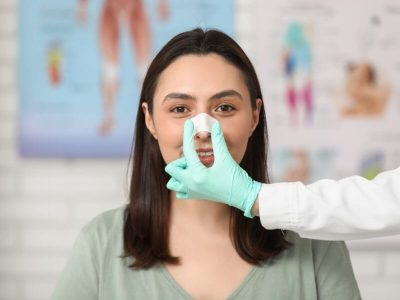
Revision Rhinoplasty
Revision rhinoplasty is a highly specialized surgical procedure performed to correct or improve the results of a previous nose surgery. Whether due to unsatisfactory aesthetic outcomes, breathing difficulties, or structural complications from the initial procedure, revision rhinoplasty is a delicate and complex operation that requires advanced surgical skill, experience, and a deep understanding of nasal anatomy.
Why Do Patients Seek Revision Rhinoplasty?
Patients may consider revision rhinoplasty for a variety of reasons, including:
- Aesthetic Concerns:
The shape, symmetry, or proportions of the nose may not meet the patient’s expectations after the initial surgery. Common issues include a pinched tip, crooked bridge, asymmetry, or irregular contours. - Functional Problems:
Some patients experience breathing difficulties or nasal obstruction after their first rhinoplasty, often due to collapsed nasal valves or compromised internal structures. - Structural Weakness or Collapse:
Over-resection (removal of too much cartilage or bone) in the first surgery can lead to a weakened nasal framework, which may collapse over time and affect both appearance and function. - Scar Tissue and Healing Issues:
Unpredictable healing, excessive scar tissue, or changes in the nose’s appearance over time may necessitate a revision.


How Is Revision Rhinoplasty Different from Primary Rhinoplasty?
Revision rhinoplasty is generally more challenging than a primary (first-time) rhinoplasty for several reasons:
- Scar Tissue: The presence of internal scar tissue from the previous surgery can make dissection more difficult and limit the surgeon’s visibility and mobility.
- Altered Anatomy: The nasal structures may have been significantly changed, removed, or weakened during the initial surgery.
- Limited Graft Material: Cartilage previously removed may need to be reconstructed using grafts, often harvested from the septum, ear (conchal cartilage), or rib.
Because of these complexities, revision rhinoplasty requires a meticulous approach, customized planning, and, in many cases, longer surgical times and recovery periods.
What to Expect During Consultation
During your initial consultation, we will:
- Review your previous surgery and medical history in detail
- Discuss your concerns and expectations
- Conduct a thorough physical examination and nasal function assessment
- Use advanced imaging or simulations to plan your ideal outcome
The goal is to set realistic expectations and ensure you fully understand the limitations and potential outcomes of the procedure.
Surgical Approach
Revision rhinoplasty can be performed using:
- Open Technique:
A small incision is made across the columella (the tissue between the nostrils) to lift the nasal skin and allow full visibility of the internal structures. - Closed Technique:
All incisions are made inside the nose, with no visible external scar. This method is used in cases requiring minimal modification.
The choice depends on the complexity of the case, the need for grafts, and the extent of correction required.
Recovery and Results
- Recovery Time: Swelling and bruising typically subside within 2–3 weeks, though subtle swelling may persist for several months. Full results may take up to a year to become fully apparent.
- Postoperative Care: Patients receive detailed instructions on how to care for the surgical site, manage discomfort, and support optimal healing.
- Results: While the goal is to significantly improve both appearance and function, revision rhinoplasty outcomes may be more limited compared to primary surgery due to tissue conditions and prior surgical changes.


Is Revision Rhinoplasty Right for You?
Ideal candidates for revision rhinoplasty are individuals who:
- Are physically healthy and do not smoke
- Have realistic expectations
- Are emotionally prepared for the possibility of gradual improvement over time
- Have waited at least 12 months after their initial surgery to allow for complete healing
If you are dissatisfied with the results of a previous nose surgery or are experiencing nasal breathing problems, revision rhinoplasty may be the solution. As a procedure that combines both technical precision and aesthetic artistry, it is essential to choose a surgeon with experience in complex nasal reconstructions.
WHO IS A GOOD CANDIDATE FOR RHINOPLASTY?
To be eligible for rhinoplasty surgery, you must be at least 18 years old. However, in rare medically necessary cases, rhinoplasty may be performed on individuals aged 16 or older, provided there is parental consent.
Beyond age, the most important eligibility criteria are determined during the physical examination and consultation. You should be able to fully understand the surgeon’s expectations, clearly articulate your desired outcome, and comprehensively appreciate potential complications—without overlooking any details. Additionally, there should be no serious health issues that could compromise your safety. These factors will be identified during the preoperative evaluation by the ENT specialist and communicated to you before surgery.
Key Eligibility Highlights
- Minimum age: 18 (or 16–17 in rare medically necessary cases with parental approval)
- Emotional and cognitive readiness: Must fully understand goals, outcomes, and risks
- Health status: No serious comorbidities that jeopardize safety
- Preoperative evaluation: ENT specialist confirms candidacy based on these criteria
RHINOPLASTY TECHNIQUES: WHICH TECHNIQUE SHOULD WE SELECT?
Because the desired outcome is more important than the technique used to perform the surgery. Determining which technique to use is a highly technical decision that requires experience and expertise. In practice, we even combine methods, using techniques across different approaches to create a hybrid procedure tailored to each patient.
WILL THERE BE VISIBLE SCARRING?
Closed rhinoplasty leaves no visible scars; open may leave a tiny scar under the nose that typically fades. Even when thetechniqe wit incision is used, in the long term this incision becomes nearly invisible.
HOW PAINFUL IS RECOVERY AFTER RHINOPLASTY?
You won’t experience significant pain during rhinoplasty surgery, and many patients don’t even use painkillers afterward. However, for the first three days, you may feel a lingering fullness and fatigue, as if you’re recovering from a bad flu.
This sensation usually starts to subside after day two, when internal nasal splints (if used) are removed, and it quickly passes afterward.
HOW LONG UNTIL I LOOK NORMAL AGAIN AFTER RHINOPLASTY?
Swelling and under‑eye bruising in the form of lines may occur during the first 7 days. After the protective nasal splint is removed, these typically rapidly diminish, and within about 3 weeks, you’ll enter a phase where swelling and bruising are no longer noticeable.
WHEN CAN I RESUME SPORTS AFTER RHINOPLASTY?
You can start light sports activities about 14 days after surgery. For contact sports, you should wait 6 weeks. After the 3rd month, you may resume any sport you wish—as long as the nose hasn’t sustained any impact
WILL MY NOSE CHANGE OVER TIME?
After the first year post surgery, your nose will start aging just like the rest of your body undergoing natural age-related changes without any additional changes caused by the rhinoplasty.